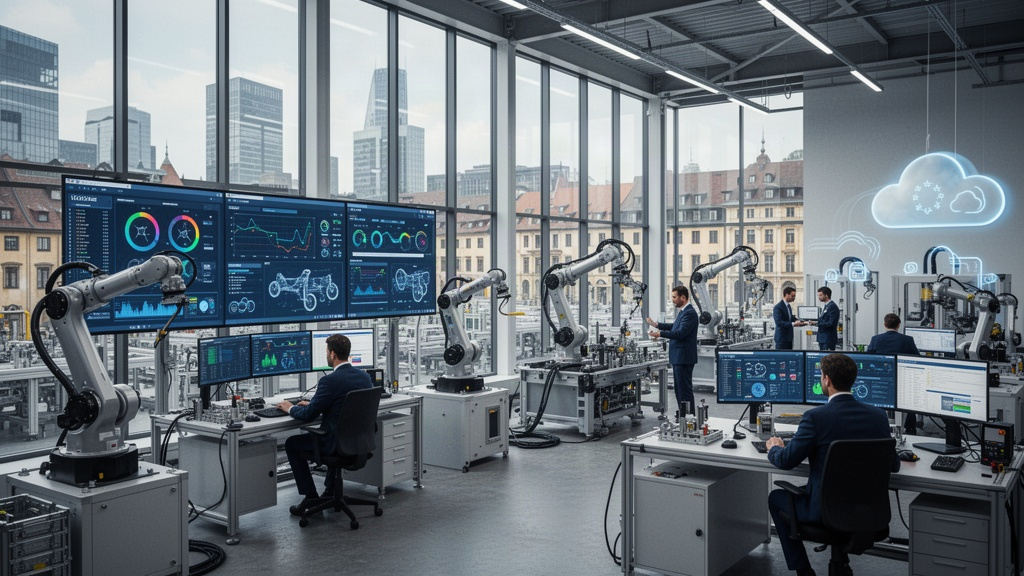
The rise of digital technologies has reshaped how businesses operate across the continent. Every european company, whether a multinational headquartered in Frankfurt or a family-run manufacturer in Kraków, now faces the same fundamental question: how fast to adapt, and at what cost. Digital transformation is no longer a distant strategic option — it is the operating reality of competitive markets. According to data from the European Commission, roughly 70% of European businesses had begun some form of digital transition by 2025, committing billions in technology investment. Yet adoption rates vary sharply by sector, company size, and geography. Understanding what this shift actually means in practice, and what separates companies that gain from it from those that struggle, requires moving past the buzzwords and into the specifics.
What Digital Transformation Actually Means for a Business
Digital transformation is the process of integrating digital technologies into every aspect of a business — changing not just the tools used, but the way decisions are made, services are delivered, and value is created for customers. It covers a wide range: cloud computing, data analytics, automation, artificial intelligence, and the digitisation of customer-facing processes. Each of these layers interacts with the others.
A logistics firm that adopts real-time tracking software is not simply upgrading its IT infrastructure. It is changing how it communicates with clients, how it measures performance, and how it allocates resources. The operational and strategic consequences ripple outward from a single technology decision. That is what makes this transformation genuinely structural rather than cosmetic.
The European Union has formally recognised this. The Digital Europe Programme and initiatives from the European Innovation Council channel public funding specifically toward helping businesses build digital capabilities. These programmes target both large enterprises and smaller operators that lack the internal resources to fund transformation independently. The policy intent is clear: digital competitiveness is treated as a matter of economic sovereignty, not just corporate strategy.
For businesses themselves, the starting point matters less than the direction of travel. A company that moves deliberately and measures its progress will outperform one that makes scattered investments without a coherent framework. The technology itself is rarely the barrier — the harder work is organisational.
Where European Companies Stand Today
The headline figure — 70% of European businesses having initiated digital transformation — tells only part of the story. Initiation and completion are very different things. Many companies have adopted one or two digital tools without integrating them into a broader operational model. True transformation, where digital processes are embedded across the value chain, remains less common.
Read also: Is V O O Stock a Safe Bet for Your Portfolio in 2026
Small and medium-sized enterprises (SMEs), defined by the EU as companies with fewer than 250 employees and annual turnover under €50 million, face a particular challenge. They represent the vast majority of businesses across Europe, yet their adoption rates lag behind larger firms. Around 30% of European SMEs report that digital transformation has measurably improved their productivity — a meaningful figure, but one that also implies the majority have yet to see clear returns.
Geography creates additional divergence. Businesses in Scandinavia and the Netherlands consistently rank among the most digitally advanced in Europe, supported by strong broadband infrastructure and high levels of digital literacy in the workforce. Companies in parts of Central and Eastern Europe face a different baseline, with infrastructure gaps and skills shortages that slow adoption regardless of intent.
Sector matters too. Financial services, retail, and media have undergone rapid digitalisation, partly driven by competitive pressure and changing consumer behaviour. Manufacturing, construction, and agriculture have moved more slowly, though the gap is narrowing as industrial automation and connected machinery become more accessible. The picture across Europe is uneven, but the direction is consistent.
The Real Obstacles Holding Businesses Back
Technology costs are often cited as the primary barrier, and for smaller businesses they are genuinely significant. Cloud infrastructure, enterprise software licences, and cybersecurity systems represent substantial ongoing expenditure. Yet cost alone rarely explains why transformation stalls. The more persistent obstacles tend to be organisational.
Skills gaps are widespread. A McKinsey & Company analysis identified the shortage of workers with data, automation, and software skills as one of the most consistent constraints on digital adoption across European markets. Hiring is difficult, retraining takes time, and the competition for qualified talent is intense — particularly in smaller cities and regions outside major tech hubs.
Read also: Explore what is financial education to improve your finances
Internal resistance also slows progress. Employees accustomed to established workflows often view digital change with scepticism, especially when the benefits to their day-to-day work are not immediately visible. Without clear communication from leadership and genuine investment in change management, technology rollouts frequently underperform.
Regulatory complexity adds another layer. European businesses operate under some of the world's most demanding data protection and compliance requirements. The General Data Protection Regulation (GDPR), while necessary, creates compliance overhead that can delay or constrain digital projects — particularly those involving customer data, AI systems, or cross-border data flows. Companies must build compliance into their digital architecture from the start, which requires legal and technical expertise that not every organisation has in-house.
Cybersecurity risk is the final major obstacle. As businesses digitise more of their operations, their exposure to cyberattacks increases. The cost of a serious breach — in downtime, reputational damage, and regulatory penalties — can outweigh the gains from digitalisation if security investment does not keep pace with adoption.
The Concrete Gains from Going Digital
Despite the obstacles, the business case for digital transformation is well-supported by evidence. Companies that have moved beyond initial adoption and embedded digital processes across their operations report consistent gains across several dimensions:
- Productivity gains from automating repetitive administrative and operational tasks, freeing staff for higher-value work
- Faster decision-making through real-time data dashboards and predictive analytics that replace slow, report-based management cycles
- Lower operational costs as cloud-based infrastructure replaces expensive on-premises hardware and reduces IT maintenance overhead
- Improved customer experience through personalised digital interactions, faster service delivery, and more responsive communication
- New revenue streams opened by digital products, subscription models, and platform-based services that were not viable before
Technology companies including SAP, Microsoft, and IBM have built substantial European practices around helping businesses capture exactly these gains. Their enterprise platforms now serve companies of all sizes, with modular pricing that has made sophisticated tools accessible to mid-market businesses that previously could not afford them.
Read also: Maximize Your Business Potential with SP 500 Insights Today
The productivity impact for SMEs deserves particular attention. The 30% of European SMEs that report measurable productivity improvements from digital transformation are not outliers — they are early indicators of what becomes possible when adoption is done with a clear operational goal rather than a vague modernisation mandate.
What Comes Next in the European Digital Landscape
Investment levels signal where attention is heading. With €5 billion committed to digital technologies across Europe by 2025, the scale of public and private funding flowing into this space is substantial. That capital is concentrating in several specific areas that will define the next phase of transformation for businesses across the continent.
Artificial intelligence is the most discussed, and for good reason. AI tools are moving from experimental pilots into mainstream business applications — in customer service, supply chain management, financial forecasting, and product development. The EU's AI Act, which sets binding requirements for high-risk AI systems, will shape how European businesses deploy these tools, creating compliance obligations but also a clearer regulatory environment than many other markets offer.
Green digitalisation is emerging as a distinct priority. European businesses face mounting pressure to reduce their environmental footprint, and digital tools — from energy management systems to supply chain carbon tracking — are increasingly positioned as instruments of sustainability as well as efficiency. Regulators and investors are both pushing in this direction.
The integration of edge computing and connected devices will accelerate transformation in industries that have so far digitalised only partially — manufacturing, agriculture, and infrastructure management among them. Processing data closer to where it is generated, rather than routing everything through centralised cloud systems, will open new operational possibilities for businesses that operate in physical environments.
Workforce adaptation will remain the defining challenge. Technology evolves faster than training systems, and the companies that invest consistently in their people's digital skills — not just their software — will hold the strongest position as the pace of change continues.