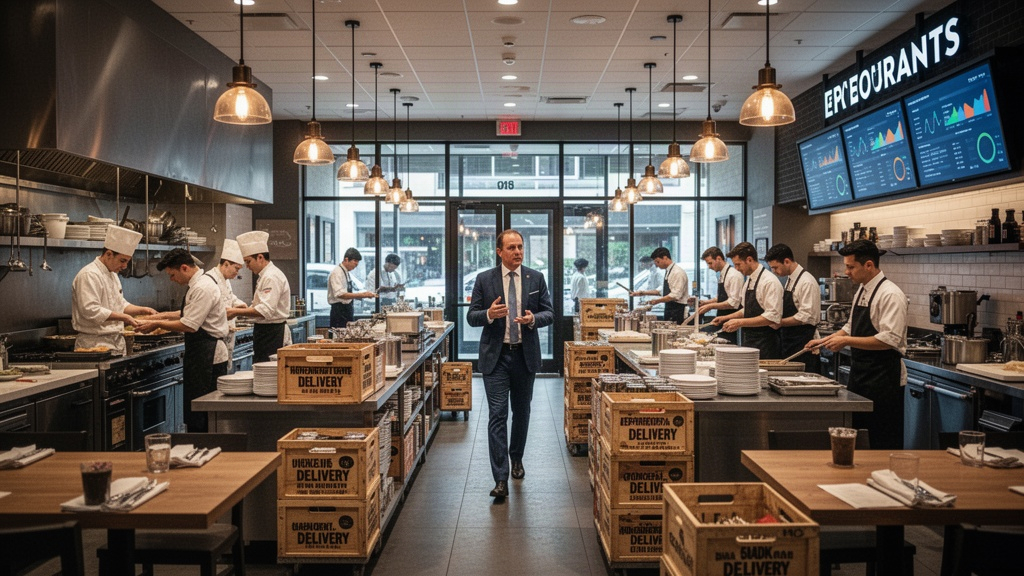
Running a restaurant chain is one of the most operationally demanding business models in the service industry. Unlike a single independent location, a multi-unit operation multiplies every challenge: staffing, supply logistics, brand consistency, regulatory compliance, and capital allocation all become exponentially harder to manage at scale. What works in one location may fail in another. Decisions that seem straightforward at the unit level become complex when applied across dozens or hundreds of sites. Multi-unit operators like McDonald's, Darden Restaurants, and Yum! Brands have built entire corporate infrastructures just to manage these variables. For smaller or growing chains, the same pressures apply with fewer resources to absorb them. Understanding where the real difficulties lie is the first step toward building a resilient operation.
Why scaling a restaurant chain creates operational complexity
The moment a second location opens, a restaurant business changes fundamentally. Operational complexity grows not linearly but exponentially, because each new site introduces its own variables: local staff, local suppliers, local regulations, and local customer expectations. The owner or founder can no longer be present everywhere at once, which means systems, training, and accountability structures must carry the operation instead.
Standardization sits at the heart of this challenge. A chain's value proposition depends on customers receiving a predictable experience regardless of location. Achieving that requires documented processes for everything from food preparation to customer complaints. Yet over-standardizing can strip away the flexibility that local managers need to respond to their specific market. Finding that balance is an ongoing negotiation, not a one-time decision.
The operational challenges that grow with scale include:
- Workforce coordination across multiple sites with different managers, shift patterns, and local labor laws
- Supply chain management, including vendor relationships, delivery schedules, and ingredient consistency
- Maintaining food safety and quality standards without direct oversight at every location
- Regulatory compliance across different states, counties, and municipalities, each with their own health and labor codes
- Brand reputation management when a single location's failure can damage the entire network
- Data and communication flow between corporate headquarters and individual sites
Centralized purchasing can reduce costs and improve consistency, but it also reduces a local manager's ability to source from nearby producers or adapt to local shortages. Communication breakdowns between head office and site managers are among the most common causes of operational drift. Chains that grow quickly without investing in internal communication infrastructure often find their standards eroding before they realize it.
Read also: The Relevance of SandP500 in Today’s Economic Landscape
The financial pressures behind multi-unit restaurant management
Managing the finances of a restaurant chain demands a level of analytical rigor that single-unit operators rarely need. Unit economics — the profitability analysis of each individual location — must be tracked separately and in aggregate. A chain that looks profitable overall may be masking several underperforming sites whose losses are offset by stronger locations.
Prime cost, the combined total of labor and food and beverage costs, is the primary lever operators can control. Labor costs in particular have risen sharply across the U.S. market, driven by minimum wage increases at the state and local level and ongoing staffing shortages. Under the Fair Labor Standards Act, non-exempt employees must be paid at least 1.5 times their regular hourly rate for hours worked beyond 40 per week — a rule that becomes especially costly when scheduling is inconsistent or poorly managed across multiple sites.
Food costs fluctuate with commodity markets, seasonal availability, and supply chain disruptions. Unlike a single restaurant that can adjust its menu quickly, a chain must balance responsiveness with the need to maintain consistent offerings across all locations. Rent and occupancy costs vary dramatically by geography, and lease structures negotiated years ago may no longer reflect current market conditions.
Technology investment adds another layer of cost. Point-of-sale systems, workforce management software, inventory platforms, and delivery integrations all require capital outlay and ongoing maintenance. These tools are no longer optional for a chain of any meaningful size, but their return on investment depends heavily on proper implementation and staff adoption. Cash flow management across multiple sites, each with its own payroll cycle and vendor payment schedule, requires dedicated financial oversight that smaller operators often underestimate.
Keeping food quality, safety and customer experience consistent
Food safety compliance is non-negotiable, and for a restaurant chain, the stakes are higher than for a single location. One outbreak of foodborne illness linked to a specific brand can trigger regulatory investigations, civil liability, and lasting reputational damage across the entire network. The FDA Food Code 2022 provides the federal reference model for food safety standards in the United States, though actual requirements vary by state and local jurisdiction. Chains operating across multiple states must harmonize their internal procedures while remaining compliant with each territory's specific rules.
Read also: 7 Key Factors to Consider When Choosing Vxus for Business
Consistency in customer experience is equally demanding. Guests who visit a chain location in one city expect the same menu, the same portion sizes, and broadly the same service quality they received elsewhere. Delivering that requires rigorous training programs, regular audits, and clear accountability at the site manager level. Many chains use mystery shoppers, digital feedback tools, and same-store sales data to identify locations where the experience is drifting from brand standards.
Allergen management deserves particular attention. A chain's purchasing team may source ingredients from multiple suppliers depending on region, and substitutions made without proper documentation can create serious health risks for customers with allergies. Supply chain transparency — knowing exactly what is in every ingredient at every location — is a legal and ethical obligation that grows more complex as the network expands. State and local health departments conduct inspections independently, so a chain cannot assume that passing inspection in one jurisdiction means compliance everywhere.
People, technology and data across the network
Staffing remains the most persistent operational challenge in the restaurant industry. High turnover rates at the hourly level mean that chains are in a near-constant cycle of recruiting, onboarding, and training new employees. When that cycle runs across dozens of locations simultaneously, the cost in time and money is substantial. Retention strategies — competitive wages, scheduling flexibility, career development pathways — require investment that not every chain budgets for adequately.
Technology has become a genuine differentiator. Workforce management platforms help operators schedule staff more efficiently, track hours in real time, and flag potential overtime exposure before it occurs. Point-of-sale systems generate transaction data that, when analyzed properly, reveal patterns in customer behavior, peak hours, and menu performance. The National Restaurant Association has noted growing adoption of digital ordering and loyalty programs as chains seek to build direct relationships with customers rather than depending entirely on third-party delivery platforms.
Read also: Key Drivers Behind Changes in VIX Stock Price Movements
Third-party delivery services offer reach but at a significant cost. Commission rates can substantially compress margins on delivery orders, and the chain loses some control over the customer experience once the food leaves the kitchen. Cybersecurity is an emerging concern: chains that collect customer payment data and loyalty program information across hundreds of locations represent attractive targets. A breach affecting one location's system can expose data from the entire network if infrastructure is not properly segmented.
Choosing the right growth model for a restaurant chain
Expansion strategy shapes nearly every other operational and financial decision a chain makes. The two primary models — company-owned locations and franchising — each carry distinct trade-offs that operators must evaluate honestly against their capital position, management capacity, and long-term goals.
Company-owned restaurants give the operator full control over standards, staffing, and financial results. Every dollar of profit stays within the business. The downside is that every dollar of investment and every operational risk also stays within the business. Scaling through owned locations requires significant capital and a management infrastructure capable of overseeing a growing portfolio without losing quality.
Franchising transfers much of the capital requirement and day-to-day operational risk to the franchisee, allowing faster geographic expansion. In the United States, the Federal Trade Commission requires franchisors to provide a Franchise Disclosure Document to prospective franchisees at least 14 days before any contract is signed or fees are paid. This document details royalties, advertising contributions, opening costs, and contractual obligations — figures that vary significantly between brands and cannot be estimated from industry averages. The franchisor gains scale and royalty revenue but sacrifices some direct control over how each location is run.
Hybrid models, where a chain owns flagship markets and franchises secondary ones, have become common among Restaurant Brands International and similar operators. The right structure depends on the brand's stage of development, its access to capital, and its ability to enforce standards through a franchisee network rather than direct management. Growth for its own sake rarely ends well. Chains that expand faster than their operational systems can support tend to see quality decline, customer satisfaction drop, and financial performance deteriorate across the network.