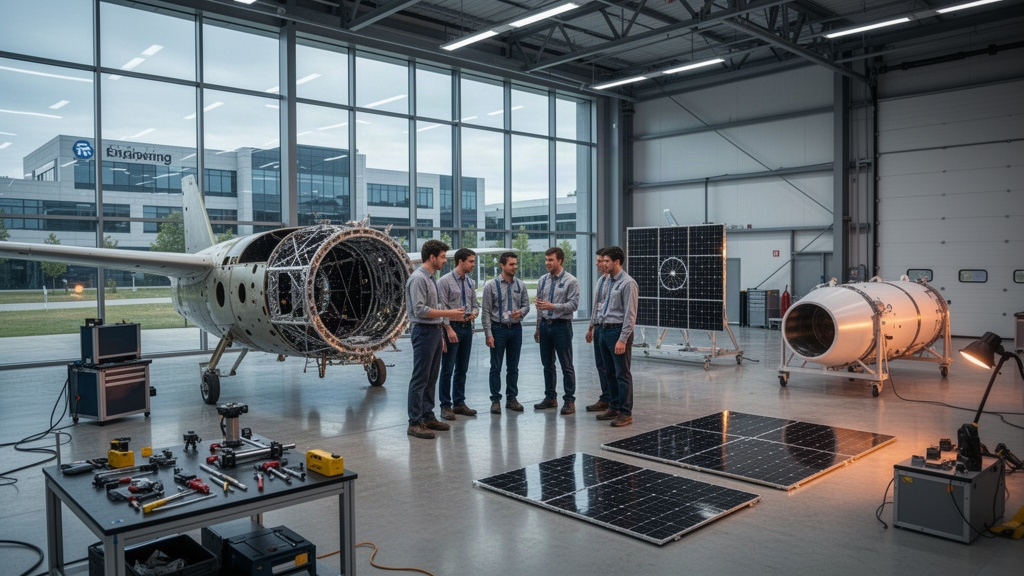
Breaking into the aerospace sector takes more than a strong GPA and a passion for flight. Aerospace companies operate across a wide range of markets, regulatory environments, and technical disciplines that most engineering programs only partially cover. Whether you are drawn to commercial aviation, satellite systems, or defense programs, understanding how these organizations actually work will sharpen your job search and help you ask the right questions before signing an offer. The U.S. Bureau of Labor Statistics recorded around 71,600 aerospace engineering jobs in the United States in 2023, with a median annual salary of $134,330 and a projected 6% employment growth through 2033. Those numbers sketch a healthy market, but they say nothing about what happens once you are inside.
How aerospace companies are organized
The aerospace sector is not a single industry. It groups together several distinct markets that share technologies but operate under different business models, regulatory frameworks, and hiring priorities. Knowing where a company sits in that structure changes everything about what your daily work will look like.
At the top of the supply chain sit the OEMs, or Original Equipment Manufacturers. Boeing, Airbus, Lockheed Martin, and Northrop Grumman design and integrate complete aircraft, spacecraft, or weapon systems. They set technical requirements that cascade down to hundreds of suppliers. Working for an OEM means exposure to full system architecture, but it also means navigating large bureaucratic structures and long program timelines that can stretch over decades.
Below the OEMs, Tier 1 suppliers deliver major subsystems directly to the prime contractor. RTX and GE Aerospace are examples of companies that supply engines, avionics, and propulsion components to multiple OEM customers simultaneously. Tier 2 and Tier 3 suppliers produce parts, materials, and sub-assemblies further down the chain. These companies are less visible but often offer faster career progression and broader hands-on responsibility earlier in your career.
Space is increasingly its own segment. SpaceX and Blue Origin operate with product development cycles that bear little resemblance to traditional defense contracting. NASA sits apart as a federal agency that both conducts research and manages contracts with industry. The MRO sector, covering Maintenance, Repair and Overhaul, employs engineers focused on keeping existing fleets airworthy rather than designing new systems. Software and autonomy are expanding segments that now cut across every other category.
What aerospace companies look for in early-career engineers
A bachelor's degree in aerospace, mechanical, electrical, or systems engineering meets the minimum entry requirement at most companies, according to the Bureau of Labor Statistics. Research positions and some advanced technical roles require a master's degree or a Ph.D. But academic credentials are only the starting point.
Read also: How Does SandP500 Compare with Other Major Indices
Technical depth matters, but so does breadth. Early-career engineers who can work across disciplines are genuinely more useful on programs that integrate structures, propulsion, avionics, and software into a single vehicle. Systems engineering thinking, which means understanding requirements, interfaces, and trade-offs at the system level rather than within a single component, is a skill that large OEMs specifically seek and that university curricula often underemphasize.
Simulation and modeling skills have become standard expectations. Proficiency in MATLAB, Python, or finite element analysis tools signals that you can contribute from day one. Quality and certification awareness also matter more than most candidates expect. Aerospace products must satisfy rigorous FAA or EASA requirements before they fly, and engineers who understand that verification and validation are not afterthoughts will stand out.
Communication is a genuine differentiator. Programs involve mechanical engineers, software developers, test pilots, program managers, and regulatory specialists working together. The ability to explain a technical constraint clearly to a non-specialist colleague, or to write documentation that survives an audit, directly affects program outcomes. Internships, co-op placements, and student competitions like those organized through SAE International give candidates concrete evidence of that capability.
Choosing between major aerospace companies, startups and suppliers
Large primes and smaller companies offer genuinely different professional experiences, and the right choice depends on what you want to learn in your first five years.
At a large OEM or defense contractor, you will likely specialize quickly. Programs are complex enough that entire teams focus on a single subsystem. The upside is depth, mentorship structures, and access to programs with significant technical ambition. The downside is that your view of the full product can become narrow, and decision-making cycles are slow. Security clearance requirements add another layer: defense programs often require U.S. citizenship and a background investigation, conditions that vary by contract, technology, and the specific role.
Read also: Why Businesses Shouldn't Underestimate 10 Years Treasury Yield
New space companies and aerospace startups move faster. At a company like SpaceX, an engineer with two years of experience may own a subsystem that would take a decade to reach at a traditional prime. The pace is real, but so is the pressure. Processes are less mature, documentation standards are still being built, and the margin for error on flight hardware is unforgiving regardless of company size.
Tier 1 suppliers occupy an interesting middle ground. Working at GE Aerospace or RTX means shipping products to multiple customers with different requirements, which builds versatility. You see how a single technology, a turbine blade or an avionics module, must satisfy Boeing's specifications on one program and Airbus's on another. That cross-customer exposure is difficult to replicate anywhere else early in a career.
Regulation, security clearances, and the realities of compliance
Aerospace is one of the most regulated industries in the world, and that regulation shapes hiring decisions, program timelines, and daily engineering work in ways that candidates rarely anticipate.
Certification is the process by which a regulator, typically the FAA in the United States or EASA in Europe, validates that an aircraft, engine, or system meets applicable safety standards. Engineers working on certified products must produce documentation, test evidence, and analysis that will withstand regulatory scrutiny. This is not bureaucracy for its own sake. It is the mechanism that keeps commercial aviation among the safest modes of transport available.
On the defense side, ITAR, the International Traffic in Arms Regulations, controls the transfer of certain defense-related technologies and technical data. Some programs require that engineers handling specific information hold U.S. citizenship or an active security clearance. These requirements are not universal, and they apply at the program and technology level rather than across an entire company. Candidates should verify the specific conditions of any role before assuming they are eligible or ineligible.
Read also: Robinhood Finance: A Comprehensive Guide to Your Success
The UK Civil Aviation Authority and the Aerospace Industries Association publish guidance relevant to engineers working in their respective markets. Understanding the regulatory body that governs the products you will work on is not optional knowledge. It shapes every design decision, every test plan, and every release to production.
How to evaluate an aerospace company before applying
Reading a job description carefully is not enough. The most useful information about a company often sits outside the posting itself, in annual reports, program announcements, regulatory filings, and conversations with engineers already working there.
Before submitting an application, work through a structured checklist of what you actually need to know:
- Program portfolio: What products is the company currently developing or producing? Are those programs in growth, maintenance, or wind-down phases?
- Technology stack: What engineering tools, simulation environments, and manufacturing processes does the team use? Are those transferable skills for your next role?
- Security and access requirements: Does the role require citizenship, a clearance, or compliance with ITAR restrictions? Confirm this before investing time in the process.
- Location constraints: Aerospace work is often tied to specific facilities. Remote work is limited for roles involving hardware, testing, or classified programs.
- Mentoring and training structures: Does the company have a formal early-career development program, or will you be expected to figure things out independently?
- Internal mobility: Can engineers move between programs, business units, or technical disciplines after their first assignment?
The Aerospace Industries Association and SAE International both publish industry data and workforce reports that help contextualize what individual companies are doing relative to sector-wide trends. Cross-referencing a company's public statements with those broader trends reveals whether their hiring pitch matches the actual direction of the market.
One angle that candidates consistently overlook is the distinction between a company's flagship programs and the work actually assigned to new hires. Being employed by a company building a next-generation launch vehicle does not mean you will work on that vehicle in year one. Ask directly which program you would join, who leads the team, and what a realistic 18-month trajectory looks like. The quality of that answer tells you more about the company than any recruitment brochure.