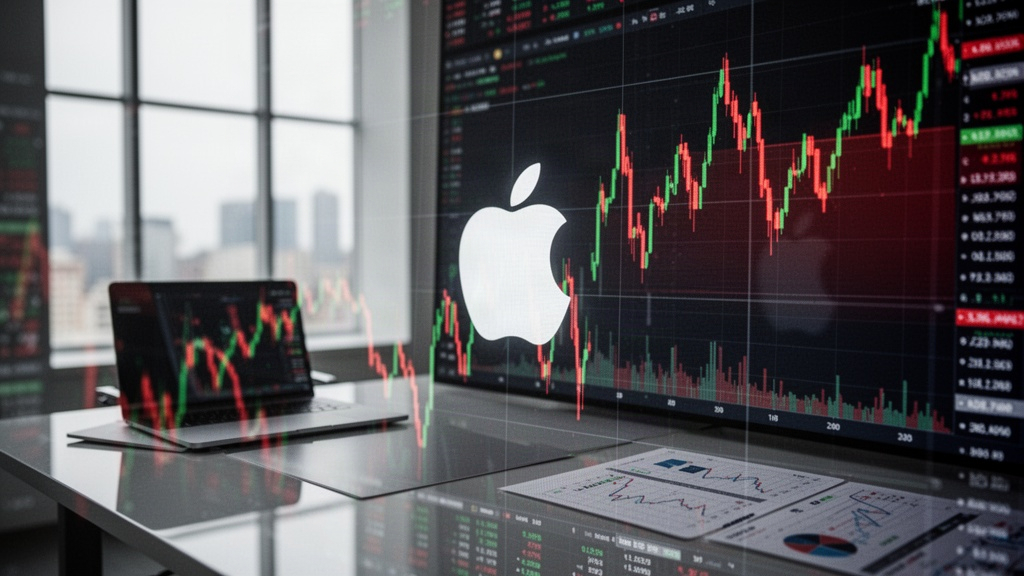
Apple Inc. stands among the most closely watched companies in the world, and the stock price Apple computer enthusiasts track daily reflects far more than a simple number on a screen. It captures investor sentiment, product cycle expectations, and macroeconomic pressures all at once. With a market capitalization hovering around $2.5 trillion as of early 2026, Apple's share price movements send ripples across the entire technology sector. Understanding what drives those movements — and what makes them so pronounced at times — gives investors, analysts, and business observers a sharper lens through which to read the broader market. Volatility is not random noise. It carries information, and decoding it around Apple specifically requires looking at several distinct layers of influence.
Factors Influencing Apple's Stock Price
Earnings reports sit at the top of the list when it comes to short-term price swings. Every quarter, Apple's revenue figures, iPhone unit sales, and services segment growth either meet or miss Wall Street analyst expectations, and the reaction is immediate. A miss by even a fraction of a percentage point on gross margin can trigger a sell-off of several billion dollars in market value within hours.
Beyond quarterly results, several structural forces shape Apple's valuation over longer time horizons:
- Product release cycles — new iPhone generations, Mac hardware refreshes, and wearables launches create anticipation that inflates or deflates share prices weeks before announcements
- Services revenue growth — the App Store, Apple Music, iCloud, and Apple TV+ collectively generate recurring income that analysts price at a higher multiple than hardware sales
- Supply chain disruptions — manufacturing concentration in Asia exposes Apple to geopolitical tensions and logistics bottlenecks that directly affect production volume
- Regulatory scrutiny — antitrust investigations by the SEC and competition authorities in the US and EU introduce legal risk that the market prices in as uncertainty
Currency exchange rates add another layer of complexity. Apple generates revenue across more than 150 countries, so a strengthening US dollar compresses international sales figures when converted back to dollars. That mechanical translation effect has moved Apple's reported revenue by hundreds of millions of dollars in both directions across different fiscal years.
Institutional ownership also shapes volatility in ways retail investors rarely consider. When large index funds and pension funds rebalance their portfolios, they buy or sell Apple shares in quantities that dwarf typical daily trading volumes. These coordinated movements create price pressure that has nothing to do with Apple's underlying business performance. The stock's weight in the S&P 500 and the NASDAQ Composite means passive investing flows alone can drive meaningful price changes on any given day.
Analyst price target revisions add fuel to the fire. When a major investment bank upgrades Apple from "neutral" to "buy" and raises its twelve-month target, algorithmic trading systems respond within milliseconds, buying shares before human traders have even read the headline. That speed amplifies moves that might otherwise be modest.
Reading the Patterns Behind Recent Price Swings
In 2023, Apple's share price experienced fluctuations of approximately 25% over the calendar year, a range that surprised investors accustomed to viewing the stock as a relative safe harbor within technology. That swing illustrated how even the most established tech companies are not immune to broader market repricing events.
The period between late 2022 and mid-2024 saw interest rate hikes by the Federal Reserve reshape how investors valued growth stocks. Higher rates increase the discount applied to future earnings, which mechanically reduces the present value of companies whose profits are projected years into the future. Apple, despite generating substantial current-year profits, carries enough growth premium in its valuation that rate movements still register on its share price.
Artificial intelligence became a defining narrative for technology stocks in 2024 and 2025. Apple's announcements around on-device AI capabilities and its partnership developments were scrutinized intensely by the market. When the company appeared to lag competitors in deploying AI features, the stock faced selling pressure. When it announced concrete integrations, the price recovered sharply. This sensitivity to AI positioning shows how quickly market narratives can override fundamental analysis.
Share buyback programs have provided a consistent floor under Apple's price during periods of weakness. Apple has returned hundreds of billions of dollars to shareholders through repurchases over the past decade, reducing the float and supporting earnings per share even when net income growth slows. Investors have come to rely on this mechanism as a stabilizing force, which partly explains why Apple's drawdowns tend to be shallower than those of smaller technology peers during broad market corrections.
Seasonal patterns matter too. The period leading into Apple's annual September hardware event typically sees elevated trading activity and heightened volatility as investors position ahead of product announcements. Post-announcement, a "sell the news" dynamic often produces a short-term price dip even when the products receive positive reviews, a pattern that has repeated reliably enough that experienced traders plan around it.
How Macroeconomic Conditions Shape Apple's Valuation
No stock trades in isolation from the economy around it, and Apple's situation makes this connection particularly visible. Consumer spending trends directly affect iPhone upgrade rates, which remain the single largest revenue driver for the company. When household budgets tighten under inflationary pressure, consumers delay hardware upgrades, and that delay shows up in Apple's sales figures within one to two quarters.
The US-China trade relationship introduces a specific geopolitical risk that few other companies face at the same scale. Apple manufactures the overwhelming majority of its products in China and simultaneously sells into the Chinese consumer market. Any escalation in tariffs, export restrictions, or diplomatic tensions between Washington and Beijing creates a dual-sided threat: higher production costs and reduced market access at the same time.
Credit conditions affect Apple even though the company itself carries a net cash position. When corporate borrowing costs rise, the broader equity risk premium increases, pulling valuations down across the market. Apple's premium multiple, which reflects investor confidence in its brand durability and earnings consistency, compresses during periods of financial stress.
NASDAQ listing means Apple trades alongside other high-multiple technology companies, and sector-wide selloffs affect it regardless of its individual fundamentals. During episodes of broad technology sector rotation, Apple can lose 10% or more in a matter of weeks simply because institutional investors reduce technology exposure as an asset class, not because anything specific to Apple has changed.
Energy prices and logistics costs feed into Apple's cost of goods sold through their effect on its manufacturing partners. While Apple does not directly operate factories, its suppliers pass cost increases through their contracts, which eventually compress Apple's gross margins if the company cannot raise consumer prices to compensate.
Navigating Investment Risk When Buying Apple Shares
The stock price Apple computer watchers monitor carries real financial risk that deserves direct acknowledgment. Size does not equal safety. Apple's enormous market capitalization creates a perception of stability that does not always match the actual price behavior during market stress events.
Concentration risk is a genuine concern for investors who hold a large proportion of their portfolio in a single stock, even one as established as Apple. A product recall, a major security vulnerability, or an adverse regulatory ruling could produce a rapid price decline that a diversified portfolio would absorb more comfortably.
The SEC requires Apple to disclose material risks in its annual 10-K filing, and reading that document reveals a candid list of factors the company itself identifies as threats to its business: dependence on a limited number of product lines, competition from well-funded rivals, and the risk of losing key personnel. These are not hypothetical concerns.
Position sizing and entry timing both influence outcomes significantly. Investors who bought Apple at peak valuations during the 2021 technology bubble faced drawdowns exceeding 30% before the stock recovered. Those same investors who held through the correction eventually saw gains, but the psychological and opportunity cost of holding through a severe decline is real and should factor into any investment decision.
Volatility measures like beta coefficients and implied volatility from options markets give investors quantitative tools to assess risk before committing capital. Apple's options market, one of the most liquid in the world, provides real-time signals about how much price movement the market anticipates around specific events. Tracking these signals alongside fundamental analysis gives a more complete picture than either approach alone.
Dividend payments, while modest relative to Apple's share price, provide a small income stream that slightly reduces the effective cost basis over time. For long-term holders, that compounding effect adds up, and it partially offsets the volatility drag that comes with holding any single equity position through multiple market cycles.